5 things living with bipolar has taught me
- Written by Leah Charles-King
- Posted: 9 October 2026
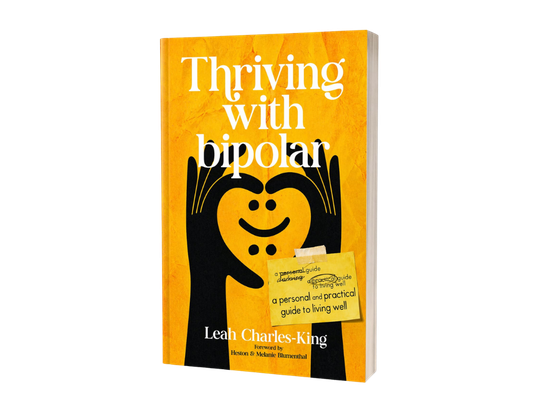
By Leah Charles-King, Bipolar UK Ambassador and author of Thriving with Bipolar: A Personal and Practical Guide to Living Well
For World Mental Health Day 2026, I wanted to share five of the biggest lessons I’ve learned from living with bipolar.
These are lessons that have taken me years to understand, often through trial and error, setbacks, recovery and learning how to work with my mental health rather than constantly fighting against it.
They’re also at the heart of my book, Thriving with Bipolar.
1. Learn your version of “well”
One of the most important things I’ve learned is that you need to know what stable looks like for you.
What’s your normal sleep pattern? Your usual energy? Your typical level of sociability, motivation, spending, confidence and activity?
The better you know your baseline, the easier it becomes to notice when something’s beginning to change. You can’t spot what’s different if you’ve never taken the time to understand what’s normal for you.
2. Your early warning signs matter
Episodes don’t always arrive out of nowhere.
Looking back, there are often signs.
Maybe you’re sleeping less. Talking more. Spending more. Becoming unusually withdrawn. Feeling increasingly irritable. Taking on too much. Losing interest in things you usually enjoy.
The signs will be different for everyone, which is why learning your own patterns is so important.
Catching a change early doesn’t guarantee that you can stop an episode, but it can give you a much better chance of responding before things escalate.

3. Stability needs protecting
For a long time, I thought managing bipolar was mostly about what you do when things go wrong.
I now understand that so much of it is about what you do while things are going well.
Sleep. Routine. Boundaries. Stress management. Medication, if prescribed. Support. Rest. Knowing your triggers.
These things can sound boring when you’re feeling good, but they’re often the very things helping you stay good.
Stability isn’t something I take for granted anymore. I protect it.

4. You have to speak up for yourself
Living with a mental health condition like bipolar often means navigating doctors, medication, services, appointments and decisions about your care.
I’ve learned that it’s important to ask questions.
If something doesn’t feel right, say so.
If you’re experiencing side effects, say so.
If you know that something’s unusual for you, say so.
Medical professionals bring clinical expertise, but you bring something equally important to the conversation: the lived experience of being you.
The best care should involve both.

5. A diagnosis doesn’t have to become your whole identity
Bipolar is part of my life, but it’s not the entirety of who I am.
I’m a presenter. An author. A speaker. A daughter. A friend. A woman with dreams, ambitions, flaws, humour, faith, experiences and a whole life outside of a diagnosis.
There were times when bipolar felt enormous.
Now I understand that living well isn’t necessarily about making bipolar disappear. It’s about building a life where the diagnosis doesn’t get to take up every seat in the theatre.
That’s what thriving means to me.
Not perfection.
Not never struggling again.
But knowing yourself, understanding what helps you stay well, recognising when you need support and continuing to build a meaningful life alongside bipolar.

BONUS: Find your people
One thing I’ve learned is that who gets a seat in your theatre really matters.
Not everyone will understand what it’s like to live with bipolar, and that’s okay. But finding people who genuinely get it can make such a difference.
There’s something really comforting about speaking to someone who doesn’t need the whole backstory. Someone who understands the highs, the lows, the fear, the medication conversations and the work that can go into staying well.
That’s one of the reasons I created The Thriving Circle, my monthly Instagram Live community, held on the first Thursday of every month, where we have honest conversations about bipolar and mental health, share practical tools and learn from each other.
Bipolar UK also runs support groups across the UK and online, where you can connect with people who understand first-hand what living with bipolar can be like.
Your circle doesn’t need to be huge.
Sometimes you just need the right people in the right seats.

This World Mental Health Day, perhaps the most useful question we can ask ourselves is: What have I learned about myself that could help me protect my mental health better going forward?
Sometimes the person we need to understand better is ourselves.
With love n’ light,
Leah
by Leah Charles-King
Thriving with Bipolar: A Personal and Practical Guide to Living Well
Thriving with Bipolar: A Personal and Practical Guide to Living Well by Leah Charles-King is available in hardback, paperback and Kindle from Amazon and at thrivingwithbipolar.co.uk.
You can also download Leah’s FREE Thinking Tool, a practical guide to help you step back from spiralling thoughts and find a more balanced way of looking at what you’re experiencing.